
You have been fine for twenty years.
Therapy for Black men across Oklahoma, online statewide and in person in Oklahoma City. A place to be a person, not just the strong one.
You are the one with the answers. You have been since you were about nine.
Being dependable runs deep and it gets a lot of men a long way. It also means nobody checks on you, because why would they. You are the one who handles it. When the car dies, when somebody gets laid off, when the family has to decide something nobody wants to decide, the phone rings and it is you.
You do not need a crisis to justify showing up here. You do not need the right words. You can walk in with "something is off and I cannot name it," and that is a real place to start.
Getting through it is not the same as being fine.
Somebody studied this in 1983 and named it after a man who won.
John Henry beat the steam drill. Then he dropped dead with the hammer still in his hand. That is the part of the story that does not make it onto the poster.
In 1983 an epidemiologist named Sherman James took that and turned it into something you can actually measure. He called it John Henryism. Prolonged, high effort coping with stress that does not let up. He said it had three parts. Mental and physical vigor. A hard commitment to work. A single minded determination to succeed.
Read that list again. That is not a diagnosis. That is a resume. It is also, more or less exactly, the thing people have been praising you for since you were nine.
Eleven years later James published the follow up and called it John Henryism and the Health of African Americans. People have been arguing about it ever since, which is the point.
James's hypothesis was that when you cope like that, and you do not have the resources to actually change the thing grinding on you, your body ends up paying for it. Later research found that among Black men, higher John Henryism scores tracked with higher systolic blood pressure and higher hypertension risk.
James, Hartnett and Kalsbeek, 1983 | Dressler et al., 1998, sample of 600 Black adultsAnd now the honest part, because you have been sold enough. This research is not settled. The Jackson Heart Study went looking and found only modest support, in men only, and the authors said out loud that it raises real questions about when and where the idea actually holds up. Nobody is handing you a number. Nobody is telling you what your blood pressure means.
What is not in dispute is the shape of it. Get set back, try harder. Do not ask anybody. Handle it. Handle it again. That strategy works, and it keeps working, right up until the day it is the thing costing you.
Racial stress is not one big event you can point at. It is the meeting, the traffic stop, the tone somebody took, the thing you decided not to say, the calculation you ran before you said the thing you did say. Every one of those is small enough to wave off. None of them is the problem. All of them together is the problem, and you have been running that math so long you stopped noticing you were doing it.
Nobody here is going to tell you to stop being the man who handles it. That man has kept people alive. But there is a difference between the work you picked up and the work that got handed to you because you were the only one who would not put it down.
You came looking for a Black man. We do not have one.
Most practices would let you find that out on your own, somewhere around the third page. Here it is up front.
Black men are about three percent of psychologists in this country. Among Black social workers holding a master's degree, roughly eight in a hundred are men.
Nationally, on the social work licensing exam between 2018 and 2021, white test takers passed on the first attempt about 84 percent of the time. Black test takers passed about 45 percent of the time.
American Psychological Association 2022, via Journal of Black Psychology 2026 | Association of Social Work Boards, 2022 exam pass rate analysis, national figuresThat second number is not a story about who is qualified. That is a gate. It is also the reason the search you have been running keeps coming up with nobody.
So here is what is actually on offer. Demetria Bonds is a Black woman. She is not going to sit there and act like she knows what it is to move through Oklahoma in your body, and if she did, you should get up and go. What she is not going to make you do is build the whole world from the ground up before you can say the thing you came to say.
That is not the thing you were looking for. We are not going to dress it up like it is.
And if that is the dealbreaker, it is a fair one. Our network page lists other providers in Oklahoma we actually trust. We would rather hand you to one of them than have you close this tab and go nowhere.
Somebody called you paranoid. Nobody asked if you were tired.
Rutgers researchers pulled 1,657 charts out of a community behavioral health clinic and found something worth knowing before you walk into anybody's office. The university put it out under the headline African Americans More Likely to Be Misdiagnosed with Schizophrenia. That is not somebody's blog. That is the school's own press office.
Black patients with severe depression were more likely to be labeled schizophrenic than white patients. Not because the symptoms were different. The depression and the mania scored about the same in both groups. The difference was what the clinician wrote down. They heard the psychotic symptoms loud and the mood symptoms quiet, and they reached for the heavier diagnosis.
Gara et al., Psychiatric Services, 2019, Rutgers Robert Wood Johnson Medical SchoolSchizophrenia is supposed to be the last thing on the list. It is a diagnosis of exclusion, which means you rule out everything else first, and depression is on the list of things you rule out. If nobody ruled it out, you did not get an assessment. You got a guess with your name on it.
Wrong label, wrong medication, years. If you have been carrying a diagnosis that never once sat right in your chest, you are allowed to say so out loud and ask for it to be looked at again. That is not you being difficult. That is you reading the same research everybody else can read.
This is not the conversation it was five years ago.
New CDC data, reported this June:
For the first time since anybody started counting, Black men between 16 and 29 are dying by suicide at a higher rate than white men the same age. It peaks between 20 and 24, at 31.9 deaths per 100,000, the highest of any age group in the report.
Black suicide deaths are up 53 percent over ten years. That is climbing more than ten times faster than the rate among white Americans. Black men are dying this way more than four times as often as Black women.
CDC data obtained by Capital B News, June 2026Across every age group put together, white men still die by suicide at nearly twice the rate. That is true and we are not cutting it to make the point land harder. The point is the young men, and the direction the line is moving.
Here is the part that is about you. The highest rates are not in Georgia or Texas, where most Black men live. They are in states with small Black populations, where a man cannot find anybody who looks like him with an opening on the calendar.
Oklahoma is about seven percent Black. And every one of our 77 counties is federally designated a mental health professional shortage area. Not most of them. All 77.
KFF and US Census via Oklahoma Health Equity Facts | Healthy Minds Policy Initiative, 2023One more thing about that age range. It starts at 16. If you are on this page because of your son and not because of you, that is a different door and we have one. See therapy for teens. Demetria works with adults.
If you are in it right now, call or text 988. Free, and it runs all night. That is not us brushing you off. It is just faster than a contact form.
Oklahoma built more Black towns than anywhere in America. Try finding a therapist in one.
Between 1865 and 1920, Black people founded more than fifty towns and settlements here. More than the Deep South. More than the Far West. More than any other state in the country. The Oklahoma Historical Society puts it plainly in its own entry: nowhere else did so many African American men and women come together to create, occupy, and govern their own communities. Thirteen are still standing.
Boley. Brooksville. Clearview. Grayson. Langston. Lima. Red Bird. Rentiesville. Summit. Taft. Tatums. Tullahassee. Vernon.
Oklahoma Historical SocietyThere is not a Black therapist in most of them. There is not a therapist in most of them.
Which is the entire reason online is on the table. You are not driving ninety minutes into Oklahoma City to sit in a waiting room and then driving ninety minutes back, and nobody here is going to pretend that was ever a realistic ask. Demetria works with men in Black Oklahoma and rural Oklahoma from wherever you already are. If you are close enough to the city and would rather be in the room, she sees clients in person in Oklahoma City too.
The person in your corner.
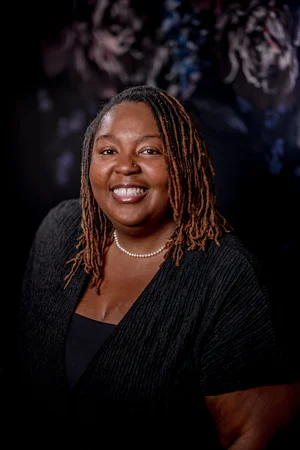
Accepting new clients across Oklahoma, online and in person in Oklahoma City. Works with Black mental health, rural communities, trauma, grief, burnout, anxiety, depression, relationships, and identity. Her hospice and palliative care background shapes how she sits with grief. She works from a trauma informed approach, is trained in Motivational Interviewing and CBT, and is a QPR Gatekeeper Instructor, which is suicide prevention training she teaches to other people.
View Demetria's ProfileThe money part, before you ask.
Plans Demetria takes
- Aetna
- Ambetter
- BlueCross and BlueShield
- FEP BlueCross and BlueShield
- Cigna and Evernorth
- Dean Health Plan
- Healthcare Highways
- Medica (Harmony)
- Mending (Taro Health)
- WebTPA
If none of those is your plan
Self pay and a sliding scale are both available. Money is not supposed to be the thing that decides this, and if it is the thing standing in your way, say so when you reach out. That conversation is not awkward on our end and we have it constantly. More on private pay.
Ala Therapy Collective does not accept Medicaid, including any carrier's Medicaid product or SoonerCare. If that is your plan, reach out anyway and we will point you toward in-network options.
You do not have to call anybody. Fill out the contact form and we verify your specific benefits before your first session, so you know your copay before anybody makes a call. Full list on our insurance page. Carrier details for Aetna, Ambetter, BlueCross BlueShield, and Cigna.
Please note: insurance benefit quotes are estimates from your insurance provider and are not a guarantee of coverage. Final responsibility for payment depends on how your insurance processes the actual claim for each date of service.
Before you reach out.
No, and we are not going to bury that at the bottom of the page. She is a Black woman. Black men are about three percent of psychologists in this country, which is why that search is going badly for you and not just here. If it is a dealbreaker, that is a fair one, and we would rather you know it now than find out in session one.
No, and it is the most common way to start. You do not need the vocabulary or a clear reason. You show up and it goes from there. If you want to know what an actual session looks like before you commit to anything, we wrote that out on what to expect in therapy.
Normal place to start. Something is off is enough to work with. Figuring out what it actually is happens to be the job.
Bring it. Black patients get labeled schizophrenic more often than white patients with the same symptoms, and it is documented, not a theory. If yours has never sat right, that is worth an honest second look rather than another decade of assuming everybody else knows better than you do.
It does not have to be. Demetria works online across Oklahoma and sees clients in person in Oklahoma City. Your truck on a lunch break counts, if that is what actually works.
Say that when you reach out. There is a sliding scale, and self pay is an option if you would rather keep insurance out of it entirely. We would rather have that conversation than have you not come.
Fill out the contact form and we set up a time to talk. Nobody chases you after that.
Reviewed by Shylah Ridgway, LCSW, LICSW, founder and clinical director of Ala Therapy Collective. Updated September 2026.
Looking for something else? See our work with couples, growing up in a hard family, anxiety and depression, trauma, and LGBTQIA affirming care. Demetria also works with polyamorous and ethically non monogamous clients. Read about online therapy across Oklahoma, or meet everybody at our network.
Therapy for Black men and African American men in Oklahoma
Whether you searched for a Black therapist, an African American therapist, Black men's therapy, African American counseling, a Black male counselor near me, or you typed something into your phone at two in the morning and hoped, it is the same page and the same work. Ala Therapy Collective provides online therapy for Black and African American men across Oklahoma.
Online therapy for Black men across Oklahoma
We work with men in Oklahoma City, Tulsa, Norman, Edmond, Lawton, Midwest City, Broken Arrow, Moore, Muskogee, Stillwater, and Enid, and statewide by secure telehealth. That includes Boley, Langston, Taft, Rentiesville, and the rest of the historic all Black towns, where the nearest therapist is not close and never has been. If you live an hour from anybody, that is the entire reason this is online.
Twenty years is a long time to be fine.
You have spent most of your life being the one who handles it. You are good at it. Nobody put a number on what that costs until somebody went looking, and you just read a few of them. Fill out the contact form and we will figure out the next step.